Natural Remedies - Healing with Medicinal Herbs
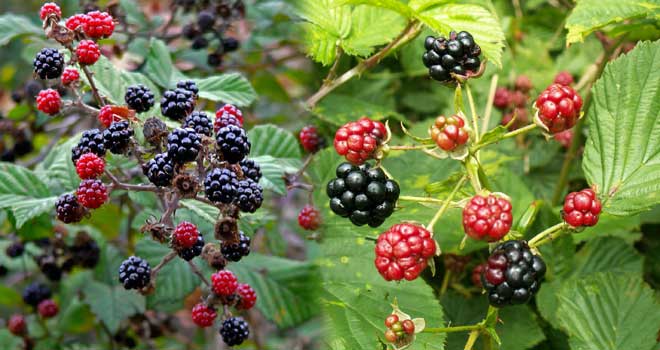
Blackberry (Rubus fruticosus Rosaceae)
Other Names: European Blackberry, Wild Blackberry
This shrub, characterized by lush, irregular growth and long, thorny stems, forms hedge-like rows and grows wild across Europe. Its leaves consist of oval leaflets with serrated edges, each with a prominent vein covered in fine hairs. White or pink flowers appear in inflorescences at the stem tips during summer, giving way to sweet, black fruits when ripe.
Parts for Use
Leaves, Roots and Fruits
- Young, delicate leaves are harvested in spring before flowering, then dried and crushed for use in infusions and decoctions.
- Fresh leaves are sometimes used externally.
- Roots are collected during summer.
- Fruits are picked in autumn when ripe.
Ingredients
Blackberry leaves are rich in tannins, organic acids (notably citric and isocitric acid), pentacyclic triterpenes, and flavonoid glycosides such as quercetin and kaempferol. Both leaves and fruits contain vitamin C.
Use in Treatment
Blackberry possesses antiseptic, antifungal, and astringent properties due to its high tannin content, which strengthens capillaries and provides antibacterial effects. The leaves are used to treat mild diarrhea and vaginal discharge and promote expectoration, making them effective for flu, colds, and coughs. Externally, blackberry leaf tincture or decoction is used as a mouthwash or gargle for sore throats, mouth ulcers, and inflammation of the oral cavity or gums. It is also applied to treat slow-healing skin ulcers, often combined with turmeric, witch hazel, or carob. A 1980 study demonstrated that blackberries lower blood sugar levels in rabbits, including both diabetic and healthy subjects, partly by stimulating insulin release.
Cultivation
Blackberries thrive in moist, well-drained soil in sunny or partially shaded locations.
Preparation and Dosage
For Internal Use (Mild Diarrhea)
- Infusion: Place one teaspoon of dried leaves in a cup of boiling water, let sit for 10 minutes, strain, and drink three cups daily between meals.
For External Use (Sore Throat, Mouth Ulcers, Oral Inflammation, and Gum Inflammation)
- Decoction: Boil 10 grams of dried leaves in 100 ml of water, let stand for 15 minutes, strain, sweeten with honey, and use as a mouthwash or gargle twice daily.
For External Use (Skin Ulcers and Injuries)
- Compress: Soak a cloth in the decoction and apply to the affected area once or twice daily.
Warnings
- No adverse effects have been observed when using blackberry leaves at prescribed doses.
- Pregnant and breastfeeding women should avoid using blackberry leaves.