Natural Remedies - Healing with Medicinal Herbs
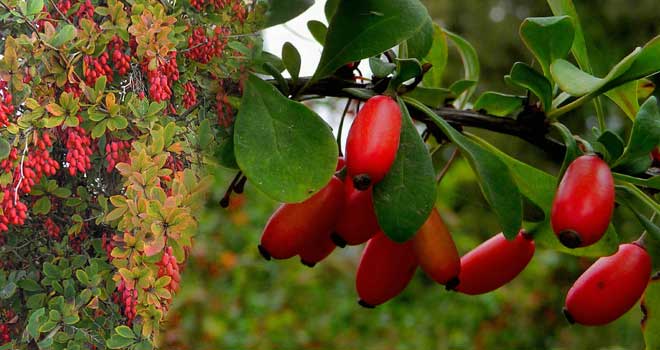
Barberry (Berberis vulgaris Berberidaceae)
Other Names: Common Barberry, Bitter Barberry, European Barberry, Gypsy Grapes
Barberry is a deciduous, prickly shrub commonly found in gardens, hedges, and shrublands across Europe. Ancient Egyptians used it to treat fever. The plant grows up to three meters tall, with furrowed yellow-gray bark, yellow wood, and yellow roots. In spring, it blooms with bright yellow flowers, followed by elongated berries in shades of pink and red.
Parts for Use
Leaves, Berries, Root, and Stem Bark
- Leaves are harvested in May and June, and ripe berries in August or September.
- The root and stem bark are collected in spring or autumn and dried to make powders, tinctures, decoctions, and other extracts.
Ingredients
The entire plant contains alkaloids, some of which may have anti-cancer properties. These alkaloids, including berbamine and berberine, contribute to the yellow color of the wood. Berberine, present in up to three percent in the root bark, has antibacterial effects.
Use in Treatment
Berberine provides several therapeutic properties. Animal studies show it reduces muscle tension and spasms, supporting digestion. Its potent antibacterial action makes barberry effective against infections like Helicobacter pylori (linked to gastritis and gastrointestinal ulcers) and oral mucosa inflammation (e.g., Candida albicans). Berberine also stimulates bile secretion, aiding the liver in removing harmful substances, which supports its traditional use for jaundice and gallstones. Externally, barberry’s anti-inflammatory properties help treat wounds, swollen eyes, eczema, psoriasis, rheumatism, hepatitis, and other inflammatory conditions. Recent Bulgarian research confirms the anti-inflammatory effects of berberine extracted from barberry roots.
Cultivation
Common barberry thrives in neutral or alkaline soil, in full sun or light shade. It can be grown from seeds or summer cuttings, but it is not recommended for producing homemade herbal preparations.
Preparation and Dosage
For External Use (Swollen Eyes and Skin Inflammation)
- Tincture (1:3 in 25% alcohol): Add 20 drops to a glass of water, soak a cloth in the solution, squeeze out excess liquid, and apply to a closed eye for 15 minutes, two to three times daily.
Warnings
- Consult a healthcare professional before use.
- Do not use barberry during pregnancy or breastfeeding.
- Avoid using barberry for food poisoning or chronic heartburn.
- Berbamine and berberine may lower blood pressure due to their anesthetic effects.
- Use barberry only under medical supervision and for no longer than six weeks.
- When using barberry as an antibacterial agent, avoid vitamin B6 and L-histidine, as they may inhibit its effects.
- Internal use of barberry should only be done under medical supervision.